Znode
with technological advances and provide the best digital experience possible.
The future is here and commerce is leading the way.
- There are a lot of different things to keep in mind when it comes to the core outcomes that’s needed from an ecommerce business.
- Faster delivery of your product on the market.
- With personalized experiences for each type of customer, you can deliver the content they want and products they prefer.
- Spend less and do more with our versatile platform’s single point of investment.
- By making future-proof investments, businesses will protect themselves against rapid change.
- Combine all your ecommerce stores into one platform with our ecommerce replatforming services.
- Eliminate ecommerce replatforming once and for all.
The modern digital buyer:
- Contrary to what was the norm in previous decades, modern buyers are doing their product research online and only engaging with salespeople when they’re ready.
- 53% of B2B buyers said content and product details are required before they select an eCommerce seller.
- Znode’s native PIM system and pricing engine makes it easy to merchandise your products effectively while also keeping prices accurate.

Modern buyers are performing the majority of product research online without interacting with sales. In fact, 53% of B2B buyers name content and product details as a top requirement when selecting B2B sellers. The ability to merchandise and serve the appropriate product to the correct customer, along with the right pricing, is simplified within Znode with the native PIM system and pricing engine.
Scalable B2B E-commerce
- If you’re a manufacturer or distributor who is serious about doing business online, supporting multiple channels becomes a necessity. Luckily, Znode Features have the necessary tools to adapt to any strategy: multi-store capabilities that allow you to easily manage your ecommerce sites, for example.
- You’ll also enjoy multiple revenue sources (B2B, D2C, and B2BX), in addition to multiple catalogs and online stores – all in one database with live synchronization.
- Big, monolithic platforms are all but extinct nowadays. What remains has morphed into legacy platforms that claim they’re “headless”. Yet they offer none of the benefits of a headless platform except APIs that check off RFP-mandated requirements.
- As Joe Ciciman, one of Forrester’s leading ecommerce analysts, said, “Headless is API.” Headless commerce has gotten the B2B ecommerce industry to where it needs to be- where it will be tomorrow. For companies looking to the future of creating optimized customer experiences with multi-channel ecommerce, modular commerce is the name of the game.
- Znode offers a headless architecture that allows commerce developers to create composite applications. This allows them to take advantage of Znode’s native capabilities and integrate high-quality third-party commerce components to provide end users with the desired experience.
Monolithic platforms are becoming extinct, supposedly. Remnants can still be found in outdated platforms claiming to be headless, but are monolithes wrapped in APIs to check boxes in RFPs. “Headless ecommerce is APIs,” to paraphrase Joe Ciciman, a leading Forrester Ecommerce Analyst. Headless ecommerce has gotten the B2B ecommerce industry to where it’s going. For companies seriously looking to the future of managing multi-channel ecommerce with optimized customer experiences, composable commerce is the future.
Znode takes headless to a new level with an API-first architecture creating the ideal ecommerce engine for composable commerce as an application approach. This allows for Znode’s native capabilities or combining best-of-breed commerce components to achieve a business’s desired customer experiences.

Znode is your one-stop shop for all your business needs:
- With Znode’s headless platform, you can customize the online experience for each of your customers.
- And with content management at the segment, account, or user level, all your webstores will have their own unique branding and theme.
- Plus, since we integrate with many business systems like ERPs and CRMs, you have more control over your selection of features and software.
- Without properly managing your product data, it can be hard to know which customers you’re targeting. Znode provides a centralized product information management system that helps you target the right set of products and creatives to the right customer bases.
- Unique catalogs and content can be managed with no issue, as well- personalizing the shopping experience for each user for ultimate customer satisfaction.
- With Znode, you can easily manage all your product listings across sites. We provide a robust set of features for B2B customers, distributors and channels so that you can scale your business without frustration.
- This includes publishing your product catalog to third party marketplaces such as Amazon, Alibaba, Walmart and more.
- With almost a majority chunk of B2B Buyers voting site search as one of most crucial features, the Znode site search provide an easy and scalable solution to enabling administrators to manage site search across multiple stores, with automatic indexing, while reducing their management complexity, increasing conversion rates and providing a better customer experience.
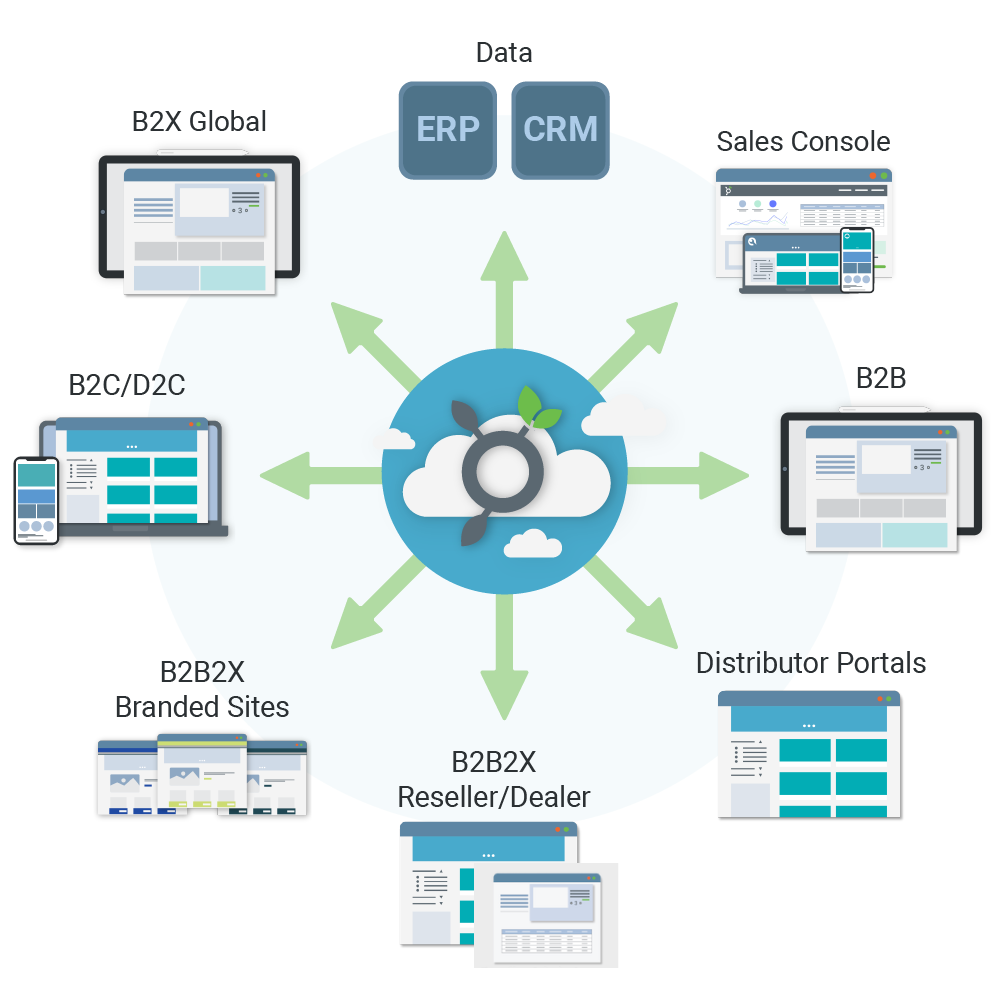
Serving B2B customers, distributors and channels is key to multi-channel ecommerce. Znode has a robust set of B2B features (and B2C and B2B2X) to make multi-channel real without excessive customizations or the need for more ecommerce platforms. This includes syndicating product catalogs to third party marketplaces like Amazon, Alibaba, Walmart, etc.
59% of B2B buyers name site search as the most important feature when selecting B2B sellers. Znode’s feature-rich native site search drives conversions and great customer experience by empowering administrators to manage search across multiple stores with automatic indexing, reducing management complexity, scale issues and heavy technical demands.
Industry leading multi-channel ecommerce platform